
05
Oct
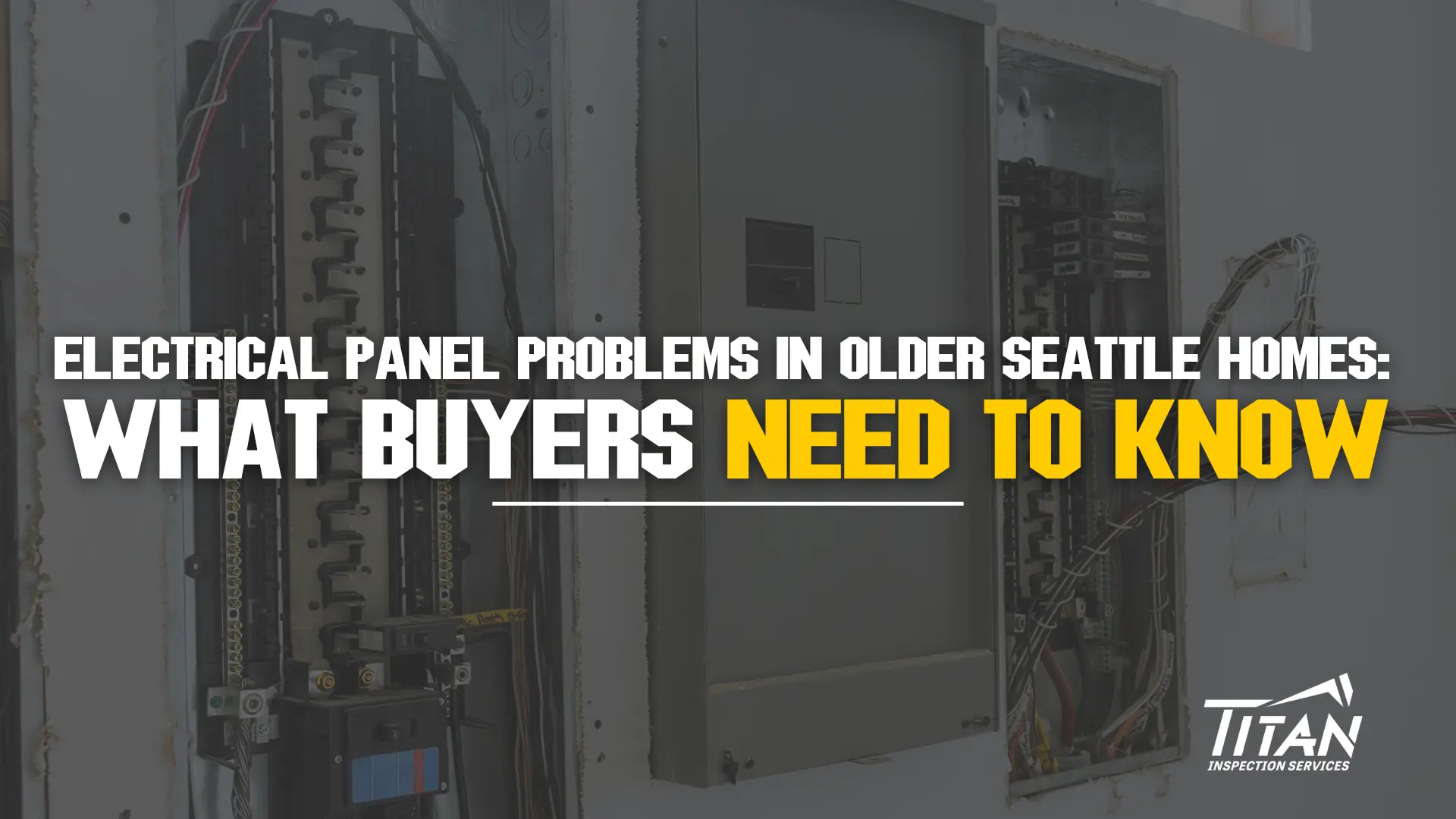
Most buyers never open the electrical panel. It is a grey metal box in the garage or the basement, and as long as the lights come on, people assume everything is fine.
Based on our 40,000+ inspections across Northwest Washington, the panel is one of the places where a house most often hides an expensive surprise. Not because anything looks broken. Because certain brands and certain wiring methods were installed for decades, passed inspection at the time, and are now considered a fire risk.
Here is what we most often find in Seattle-area homes, what each one means, and how much it costs to deal with.
Federal Pacific Stab-Lok Panels
If your home was built or rewired between roughly 1950 and 1990, there is a real chance the panel is a Federal Pacific Electric Stab-Lok. They were installed in millions of homes across the country.
The concern is the breakers. A circuit breaker has one job: when a circuit draws more power than it should, the breaker trips and cuts the power. Independent testing has found that a meaningful share of Stab-Lok breakers fail to trip when they should. The handle moves. The power stays on.
That matters because a breaker that does not trip lets the wire behind your wall keep heating up. This is the failure mode that starts fires inside walls, where nobody sees it until there is smoke.
You can identify one yourself. Open the panel door and look for the Federal Pacific or FPE label, or a row of breakers with red or orange stripes on the handles. Do not remove the cover. That is our job, and there are live parts behind it.
Key Takeaway: Federal Pacific Stab-Lok panels were installed in millions of homes from the 1950s through the 1980s, and testing has shown their breakers can fail to trip under load. A breaker that does not trip can turn an overloaded circuit into a fire inside a wall. Look for the FPE label on the panel door.
Zinsco and Sylvania-Zinsco Panels
Zinsco panels show up in homes from the 1950s through the 1970s, often under the Sylvania name after the two companies merged.
The problem here is different. In a Zinsco panel, the breaker connects to an aluminum bus bar, and that connection can overheat and melt. Once it melts, the breaker fuses to the bus and can no longer trip. You end up with a breaker that is physically stuck in the on position.
The tell is usually visible once the cover comes off. We look for scorch marks on the bus bar, discoloration around the breaker contacts, and breakers that do not sit square. A panel with visible burning is not a wait-and-see item.
Aluminum Branch Wiring
Between about 1965 and 1973, copper prices spiked, and many homes were wired with aluminum instead. Not the thick aluminum feeder cable running to your panel, which is normal and fine. The thin aluminum wire running to outlets and switches.
Aluminum expands and contracts more than copper as it heats and cools. Over decades, that movement loosens the screw connections at outlets and switches. A loose connection arcs, generating heat right where the wire meets the device.
Full rewiring is expensive and usually unnecessary. The accepted repair is to pigtail the connections, which means splicing a short piece of copper onto the aluminum wire at each device using a connector rated for that purpose. It is tedious work, but it is far cheaper than opening every wall.
Key Takeaway: Aluminum branch wiring was common in homes built between 1965 and 1973, and the risk lies in loose connections at outlets and switches rather than in the wire itself. Pigtailing each connection with a rated connector is the standard fix and costs far less than a full rewire.
Panels That Are Simply Full or Undersized
Not every panel problem is a brand problem. Plenty of Seattle homes have a perfectly good panel that has run out of room, or that was sized for a house with far fewer appliances than it has now.
A 100-amp service was standard for decades. Add a heat pump, an induction range, and an electric vehicle charger, and 100 amps stops being enough. We also see double-tapped breakers, where two wires are jammed under a screw designed for one, and we see panels where the covers no longer close because someone kept adding circuits.
None of this is a deal breaker. It is just work that needs doing, and it is worth knowing before you own it rather than after.
What This Costs
Prices vary by the electrician and by how the panel is placed, but these are the ranges we typically see quoted in the Seattle area.
Replacing a Federal Pacific or Zinsco panel with a modern one runs roughly $3,500 to $5,000 for a like-for-like swap at the same amperage.
Upgrading service from 100 amps to 200 amps incurs an additional cost, generally $2,500 to $3,500, because it usually involves the meter base and coordination with the utility.
Pigtailing aluminum branch wiring runs roughly $1,500 to $4,000 depending on how many circuits and fixtures are in the house as well as ease of access.
Adding a circuit or correcting a double-tap is a small job, often a few hundred dollars.
Electrical work in Washington requires a permit and an inspection by the state. Washington Labor and Industries publishes what homeowners and contractors are allowed to do and when a permit is required. The Electrical Safety Foundation is a good plain-language source on why these failures happen.
Key Takeaway: A like-for-like panel replacement usually runs $3,500 to $5,000; a 100- to 200-amp service upgrade runs $2,500 to $3,500; and pigtailing aluminum wiring runs $1,500 to $4,000. Washington requires a permit and a state inspection for electrical work, so budget for that alongside the labor.
What Our Inspectors Do at the Panel
We remove the panel cover on every home inspection, which is the only way to see most of what matters. Here is what we are checking.
The panel brand and whether it is a known problem model. Scorching, corrosion, or melted insulation on the bus bar or breaker contacts. Double-tapped breakers. Breaker sizing against the wire it protects, because a 20-amp breaker on 14-gauge wire defeats the whole point. Whether the ground and neutral are properly separated at a subpanel. Missing knockouts and open holes in the enclosure. Whether the panel has room to grow.
We also check that bedrooms and living areas have working smoke alarms, and that kitchens, bathrooms, garages, and exterior outlets are on GFCI protection. A GFCI outlet cuts power fast when it detects current going somewhere it should not, and it is the single cheapest safety device in a house.
Older wiring problems often travel together. If you are looking at a home old enough to have a questionable panel, it is worth reading our guide to knob-and-tube wiring in older Seattle homes as well, since the two frequently turn up in the same house.
Frequently Asked Questions
Is a Federal Pacific panel an automatic deal breaker?
No. It is a repair item with a known cost, much like a roof near the end of its life. Most buyers who find one negotiate a credit or ask for replacement before closing rather than walking away. What you should not do is ignore it, because insurers are increasingly asking about panel brands and some will decline coverage until it is replaced.
Can I just replace the breakers instead of the whole panel?
Not reliably. Replacement breakers for these panels exist, but they use the same design as the originals, and the underlying issue is the connection between the breaker and the bus. Electricians in this area almost always recommend replacing the panel, and that is the option most homeowners choose.
Does aluminum wiring mean I have to rewire the house?
Almost never. The standard repair is pigtailing, where a short copper lead is spliced to the aluminum at each outlet and switch using a connector rated for aluminum-to-copper connections. It addresses the actual failure point without opening walls, and it costs a fraction of the cost of a rewire.
How can I tell what brand my panel is before an inspection?
Open the outer door, which is the part that swings like a cabinet door, and look for a label inside it or on the face. Federal Pacific panels usually say FPE or Federal Pacific and often have red or orange breaker handles. Zinsco panels may say Zinsco or Sylvania. Leave the inner cover alone, since there are exposed live parts behind it.
Will an inspection tell me if the wiring behind my walls is safe?
An inspection is visual, so we report on what can be seen and safely accessed. We check the panel, the outlets, the switches, and any wiring visible in the attic, garage, and crawl space. If what we find suggests a problem inside the walls, we say so and recommend an electrician evaluate it further.
Does Titan check the electrical system on every inspection?
Yes. Electrical is one of the standard systems we evaluate on every home inspection, alongside the roof, attic, foundation, plumbing, heating, and the rest. You can see the full list on our what we inspect page.
Schedule Your Inspection
Titan Inspection Services has completed more than 40,000 inspections across Northwest Washington and holds a 4.9-star rating. Every inspection covers 150+ items and includes over 250 photos, so you get to see what we saw rather than take our word for it.
Pricing for a home inspection is listed by square footage on our site. Call 206.451.1120 or visit titaninspectionservices.com to get on the schedule. We can usually get you in the same day, and your full report lands within 24 hours.